Debunking Hinduism, Islam, New Age and explaining religion
Intro
Generally people at this time and age, like to think of religion as something dark and despicable and full of fantasy. The truth here is, God is one, he gave us one word (the Bible, as we saw in the previous article) but different interpretations of God's word, sometimes in an alarmingly wrong way (Quran) gave rise to orthodox religions that are mostly cultic and strict into making believers of them adhere to their laws and propaganda. Today, we will debunk a few of them that are major and distinct. The core beliefs are as written by Marilyn and will be reviewed and debunked by me.
Hinduism and its beliefs
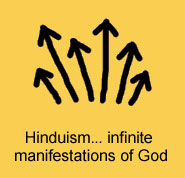 Most Hindus worship one Being of ultimate oneness (Brahman) through infinite representations of gods and goddesses. These various deities become incarnate within idols, temples, gurus, rivers, animals, etc.
Hindus believe their position in this present life was determined by their actions in a previous life. Hinduism therefore provides a possible explanation for suffering and evil in this life. If a person’s behavior before was evil, they might justifiably experience tremendous hardships in this life. Pain, disease, poverty or a disaster like a flood is deserved by that person because of their own evil actions, usually from a previous lifetime.
A Hindu's goal is to become free from the law of karma...to be free from continuous reincarnations. Only the soul matters which will one day be free of the cycle of rebirths and be at rest.
Hinduism gives a person freedom to choose how to work toward spiritual perfection. There are three possible ways to end this cycle of karma: 1. Be lovingly devoted to any of the Hindu deities; 2. Grow in knowledge through meditation of Brahman (oneness)...to realize that circumstances in life are not real, that selfhood is an illusion and only Brahman is real; 3. Be dedicated to various religious ceremonies and rites.
Though the philosophy behind it is unique and good in a way a person must live and is totally based on one's deeds and not how to realize and serve the purpose for which God made us. Polytheism is kinda a delusional topic.
How is it possible for a number of Gods to exist coherently at the same time?
It is actually vast. 33 million Gods (goddesses) each with countably different powers which, on its base, actually developed through imaginativeness of poets and writes of ancient lore of a time when kings and queens of ancient Indian history was revered to be equal to Gods. Though, the core words of God here exactly corroborate with the Bible. Priests who chant mantras from vedas, etc. Fail to understand their actual meaning. Look up sadhu chellappa to discover Jesus through the vedas. Most other "holy books" are just exaggerations of great kings. Though the core concept is the same as that of Christianity, idolatory and other misguidings make it flawed.
Read this http://www.jeevanmarg.com/testimonies/sadhu-chellappa-finding-jesus-christ-from-vedas/
New Age and its beliefs
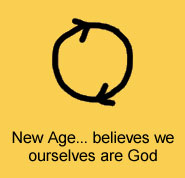 New Age promotes the development of the person's own power or divinity. When referring to deity, a follower of New Age is not talking about a transcendent, personal God who created the universe, but is referring to a higher consciousness within themselves. A person in New Age would see themselves as deity, the cosmos, the universe. In fact, everything that the person sees, hears, feels or imagines is to be considered divine.
Highly eclectic, New Age presents itself as a collection of ancient spiritual traditions. It acknowledges many gods and goddesses, as in Hinduism. The Earth is viewed as the source of all spirituality, and has its own intelligence, emotions and deity. But superseding all is self. Self is the originator, controller and power over all. There is no reality outside of what the person determines.
New Age teaches a wide array of eastern mysticism and spiritual, metaphysical and psychic techniques, such as breathing exercises, chanting, drumming, meditating...to develop an altered consciousness and one's own divinity.
Anything negative a person experiences (failures, sadness, anger, selfishness, hurt) is considered an illusion. Believing themselves to be completely sovereign over their life, nothing about their life is wrong, negative or painful. Eventually a person develops spiritually to the degree that there is no objective, external reality. A person, becoming a god, creates their own reality.
This is utterly stupid as it does not answer the question of creation, salvation or the purpose of life and it claims mortals, with finite abilities can be God. This questions the essential meaning of who God is and is absolutely a misleading concept of infidelity.
Buddhism and its beliefs
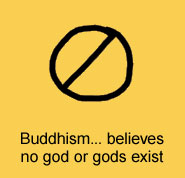 Buddhists do not worship any gods or God. People outside of Buddhism often think that Buddhists worship the Buddha. However, the Buddha (Siddhartha Gautama) never claimed to be divine, but rather he is viewed by Buddhists as having attained what they are also striving to attain, which is spiritual enlightenment and, with it, freedom from the continuous cycle of life and death. Most Buddhists believe a person has countless rebirths, which inevitably include suffering. A Buddhist seeks to end these rebirths. Buddhists believe it is a person's cravings, aversion and delusion that cause these rebirths. Therefore, the goal of a Buddhist is to purify one's heart and to let go of all yearnings toward sensual desires and the attachment to oneself.
Buddhists follow a list of religious principles and very dedicated meditation. When a Buddhist meditates it is not the same as praying or focusing on a god, it is more of a self-discipline. Through practiced meditation a person may reach Nirvana -- "the blowing out" of the flame of desire.
Buddhism provides something that is true of most major religions: disciplines, values and directives that a person may want to live by. This is a mix of the positive values taken from teachings of other religions. And that is it. Nothing related to God here either.
Islam and its beliefs
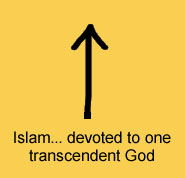 Muslims believe there is the one almighty God, named Allah, who is infinitely superior to and transcendent from humankind. Allah is viewed as the creator of the universe and the source of all good and all evil. Everything that happens is Allah's will. He is a powerful and strict judge, who will be merciful toward followers depending on the sufficiency of their life's good works and religious devotion. A follower's relationship with Allah is as a servant to Allah.
Though a Muslim honors several prophets, Muhammad is considered the last prophet and his words and lifestyle are that person's authority. To be a Muslim, one has to follow five religious duties: 1. Repeat a creed about Allah and Muhammad; 2. Recite certain prayers in Arabic five times a day; 3. Give to the needy; 4. One month each year, fast from food, drink, sex and smoking from sunrise to sunset; 5. Pilgrimage once in one's lifetime to worship at a shrine in Mecca. At death -- based on one's faithfulness to these duties -- a Muslim hopes to enter Paradise. If not, they will be eternally punished in hell.
For many people, Islam matches their expectations about religion and deity. Islam teaches that there is one supreme deity, who is worshiped through good deeds and disciplined religious rituals. After death a person is rewarded or punished according to their religious devotion. Muslims believe that giving up one’s life for Allah is a sure way of entering Paradise.
This is a totally misunderstood interpretation of who God is and is essentially different from Christianity. They believe in rules and regulations and that their duties are the only way to hope to enter paradise, there is no surefire way and here too, we find no answer to the question of the purpose of our existence on this planet. It also has policies and principles that contradict God's loving nature. Killing unbelievers (jihad) and many other human-minded concepts are believed. Flawed idealism is present here.
Christianity and its beliefs
 Christians believe in a loving God who has revealed himself and can be known in a personal way, in this life. With Jesus Christ, the person's focus is not on religious rituals or performing good works, but on enjoying a relationship with God and growing to know him better.
Faith in Jesus Christ himself, not just in his teachings, is how the Christian experiences joy and a meaningful life. In his life on Earth, Jesus did not identify himself as a prophet pointing to God or as a teacher of enlightenment. Rather, Jesus claimed to be God in human form. He performed miracles, forgave people of their sin and said that anyone who believed in him would have eternal life. He made statements like, "I am the light of the world; he who follows me will not walk in darkness, but will have the light of life."1
Christians regard the Bible as God's written message to humankind. In addition to being an historical record of Jesus' life and miracles, the Bible reveals his personality, his love and truth, and how one can have a relationship with him.
Whatever circumstances a Christian is dealing with in their life, the Bible teaches that they can confidently turn to a wise and powerful God who genuinely loves them. They believe that he answers prayer and that life takes on meaning as they live to honor him.


Comments
Post a Comment